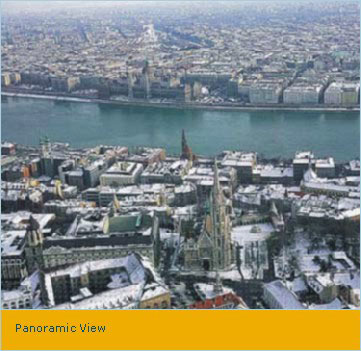
Geographical location > view
map
Hungary is located in Central Europe, in the Carpathian
basin, among seven neighbouring countries (Slovakia, the Ukraine,
Romania, Yugoslavia, Croatia, Slovenia and Austria).
Area: 93,030 sq kilometres
Total length of the state borders: 2,216.8
km
|
Population: 10.19 million persons, Capital
city: Budapest (pop 2 million)
|
People: 89.9% Hungarian, 4% Gypsy, 2.6% German,
0.8% Slovak & 0.7% Romanian
Religion: 68% Roman Catholic, 21% Reformed (Calvinist),
6% Evangelical (Lutheran), 5% Other
|
Official language: Hungarian
Official currency: Forint
|
Government: Parliamentary democrac
President: Ferenc Madl
|
Highest peak: Kékes (1014 m), Lowest
point: Gyálarét (78 m)
Main rivers: Duna (Danube) (length in
Hungary: 417 km), Tisza (length in Hungary: 596 km),
Lajta, Rábca, Rába, Zala, Dráva, Ipoly, Zagyva, Sajó,
Hernád, Bodrog, Szamos, Hármas-Körös and Maros
Largest lakes: Balaton (596 square kilometres), Velencei-tó
(26 square kilometres), Fertő tó (southern part, 75 square kilometres)
Geographic regions: Alföld (Great Plain), Kisalföld (Small
Plain), Nyugat-Magyarországi peremvidék or Alpokalja (Western Hungary
or Lower Alps), Dunántúli-dombság (Transdanubia hills), Dunántúli-középhegység
(Transdanubia mountain range) and Északi-középhegység (Northern
mountain range)
|

Climate
Hungary is situated in the temperate zone, on the borderline of,
and affected by, three large climatic zones: oceanic, continental
and Mediterranean. It is prone to rhapsodic weather changes and,
due to the relative isolation of the Carpathian Basin, the climate
has a tendency for droughts, especially on the Great Plain.
The annual average mean temperature is 9.7 °C in the whole of the
country and 11.2 °C in Budapest. The mean temperature in the hottest
month, July, is 20.0 °C, in the coldest month, January, 2.1 °C.
On a hot summer day temperatures may reach 33-38 °C, while in cold
winters temperature may drop to -25.0. -30.0 °C.
In the central part of the Great Plain the annual average rainfall
varies between 470-550 mm, in the mountains, 700-800 mm. The number
of days when the land is covered with snow is relatively few.
The number of hours of sunshine varies between 1700-2200 hours
per year, the area between the rivers Danube and Tisza being the
most sunny, while the regions with the least amount of sunshine
are the Alpokalja (Lower Alps) and the Northern mountains.The annual
average wind speed is 2.4 m/sec.
|
Official holidays
1 January (New Year's Day),
15 March (start of the 1848/49 revolution
and war of independence, national holiday)
1 May (Labour Day),
20 August (foundation of state, celebration
of King Saint Stephen, national and state holiday),
23 October (start of the 1956 revolution
and war of independence, date of the declaration of
the Republic of Hungary in 1989, national holiday),
25-26 December (Christmas),
1 November (All Saints' Day)
Events
Hungary's major celebration is the Budapest Spring Festival (March),
a two-week cultural extravaganza of local and international performances,
conferences and exhibitions. Other important events include: the Budapest
Film Festival (February), which premieres new Hungarian
films; Busójárás (Mohás; February also), the nation's
top Mardi Gras; Sopron Festival Weeks (Sopron;
June/July), showcasing ancient music and dance performances; the Folk
Arts Festival (Nagykálló; August), one of the biggest
and best events of the year; and Jazz Days (Debrecen;
September), which is Hungary's top jazz festival.
|
Parts of the World Heritage
Hungarian treasures included in the World Heritage list of
the United Nations Educational, Scientific and Cultural Organisation
(UNESCO):
- In Budapest, the panorama of the two banks of
the River Danube in Budapest and the Buda Castle District (on the
Buda side, the section from the Buda bridgehead of Petőfi bridge
to Víziváros (Water Town) and the Castle Hill including the Gellért
Hill and the Tabán, and on the Pest side the area between the Pest
bridgehead of Margaret bridge and Petőfi bridge including the Parliament
(1987),
- Hollókő, the 55 authentic houses in the old
village among the Cserhát hills (1987),
- Aggtelek stalactite cave system, stretching
into Slovakia (1995),
- the Benedictine Abbey and church in Pannonhalma,
the Millenary Monument, the Stations of the Cross and the Blessed
Virgin's chapel (1996),
- Hortobágy National Park, one of the largest
and protected short-grass plains in Europe, including the Nine-hole
bridge in Hortobágy, the Hortobágy Inn and the Shepherd Museum
(1999),
- the complex of early Christian monuments in Pécs:
the burial hall and its painted chambers (2000).
|
Currency Exchange, Banks
Currency
The official means of payment in Hungary is the Forint (Ft, HUF).
Coins: 1, 2, 5, 10, 20, 50, 100 HUF.
Bank notes: 200, 500, 1,000, 2,000, 5,000, 10,000, 20,000 HUF.
Exchange
In Hungary there are 28 banks (800 branches), 84 Savings banks
(260 branches) and 599 businesses (2230 offices) involved in exchange.
There is no mandatory minimum amount for currency exchange.
Banks
In Hungary banks are usually open between 8 .00 - 16.00 on weekdays.
Some banks are open on Saturday, but all are closed on Sunday.
ATM machines and currency exchange machines are available throughout
the country.
The credit cards used most often - AMEX, Diners Club, EnRoute,
Euro/Mastercard, JCB, VISA - can be used to withdraw cash from
banks and ATM machines and to pay bills in hotels, restaurants
and shops. Emblems at the entrance mark the shops where credit
cards are accepted. Most banks have their own automated networks.
Detailed information is available on the Bankcard home page.
You can use your bank or credit card to get cash at post offices
throughout Hungary. More than 3200 post offices nation-wide provide
this service.
|
Online Currency
Calculator
|
|
|
Currency
|
Buying
|
EUR
|
 |
254.90
|
USD
|
 |
228.46
|
GBP
|
 |
362.85
|
CHF
|
 |
164.05
|
SEK
|
 |
28.05
|
NOK
|
 |
30.85
|
DKK
|
 |
34.32
|
JPY
|
 |
1.967
|
PLN
|
 |
57.13
|
CZK
|
 |
7.80
|
SKK
|
 |
6.17
|
|
|
Telephone
Country Code for Hungary: 36
City Code for Budapest: 1
Domestic long-distance call prefix: 06
International calls: 00 + country code + phone
number Domestic long distance calls: 06 + area code + local phone
number
Useful Phone Numbers:
- Telephone wakening service: 193
- Domestic telegram service: 192
- Directory inquiries: 198
- International directory inquiries: 199
- MATÁV Inquiry Plus: 197
- Special inquiry: 267-6767
- Inquiry about issues (yellow line): 397-9797
- Domestic announcement: 191 (when phoning parties that can’t be
called directly, it allows users to call them through a telephone
exchange)
- International announcement: 190 (to make an international call
through a post office)
Telephone numbers in Budapest consist of 7 numbers; phone numbers
elsewhere in Hungary consist of 8 numbers, one-digit area code
first. Additional services: Hungary Direct, Country Direct, Green
number and Blue number.
Public Phones
The public phones work with 10, 20, 50 and
100 HUF coins or with phone-cards available at hotels, post
offices, petrol stations, newsagents, kiosks and street vendors.
The minimum charge for a call is 20 HUF.
|
|